
Galata Tower Facts: Height, Materials and Why It's Famous
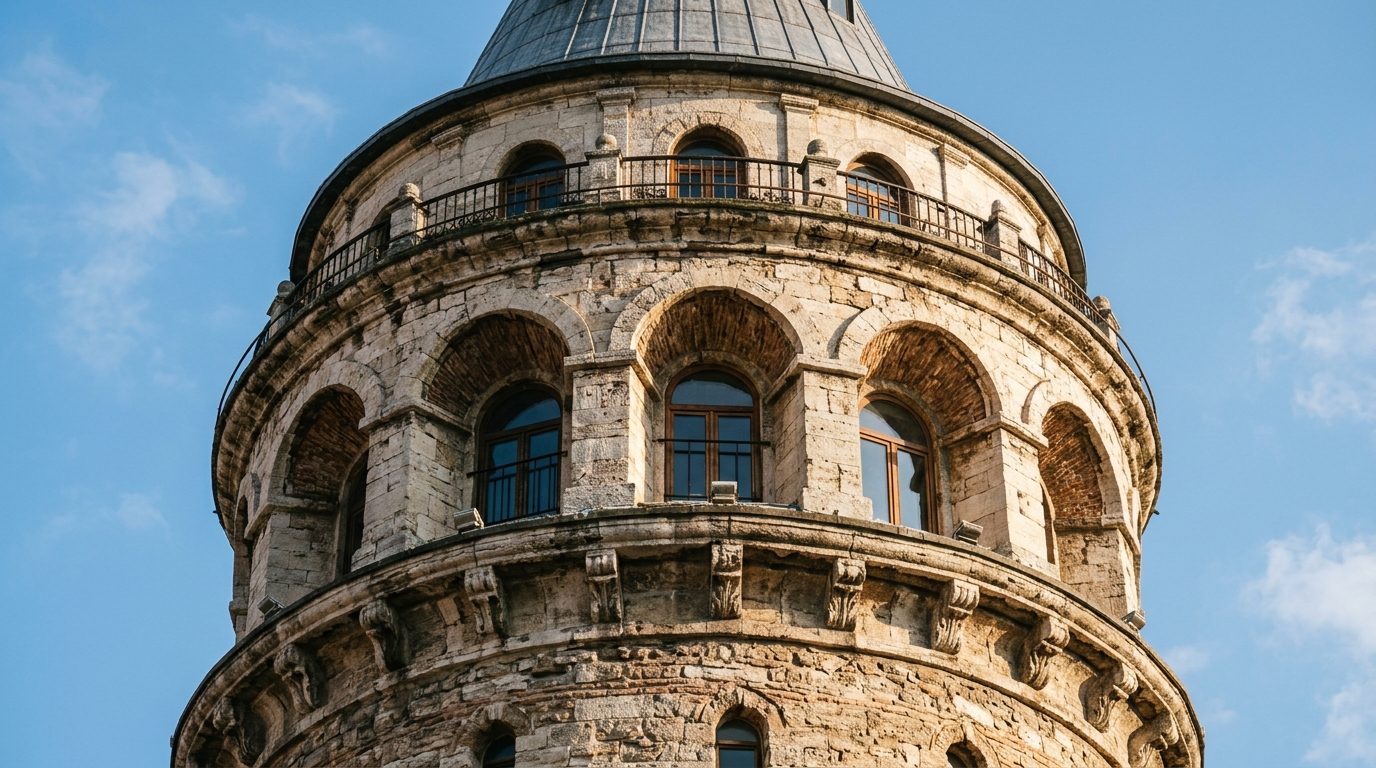
Galata Tower is about 62.6 metres tall, built of rough-cut stone with walls up to 3.75 metres thick, completed by the Genoese in 1349 — making it roughly 675 years old — and famous as the medieval watchtower that still defines Istanbul’s northern skyline. Those are the headline numbers; here is the full fact file, with the context that makes each figure interesting.
The vital statistics
| Fact | Figure |
|---|---|
| Height to roof tip | ~62.6 m |
| Observation balcony height | ~51.7 m above street level |
| Storeys | 9 |
| Outer diameter | ~16.5 m |
| Inner diameter | ~9 m |
| Wall thickness at base | ~3.75 m |
| Built | 1348–1349 |
| Builders | The Genoese colony of Galata |
| Original name | Christea Turris (“Tower of Christ”) |
| Steps to the top | ~146 (elevator available) |
| Status today | Museum (since October 2020) |
How tall is Galata Tower, really?
The stonework rises about 62.6 metres from the pavement to the tip of the conical roof — nine storeys of medieval masonry. But the tower cheats magnificently: it stands near the top of Galata hill, several dozen metres above the waterline, so from a ferry on the Golden Horn it reads far taller than any single number suggests. That borrowed height is the whole point — the Genoese built a watchtower, and a watchtower’s job is to see and be seen. For centuries it was the tallest structure on the city’s northern shore.
The balcony you visit circles the tower at about 51.7 metres — the exact vantage point the medieval watchmen used, minus their 146-step commute.
What is Galata Tower made of?
Rough-cut local stone — a rubble masonry of limestone and sandstone bonded with lime mortar — in walls that taper from a staggering 3.75 metres thick at the base. That thickness is why the tower reads as mighty outside yet surprisingly snug inside: of its 16.5-metre outer diameter, nearly half is solid wall. It’s also why the tower is still here. It has shrugged off earthquakes, at least two major fires and a roof-stealing storm in seven centuries; the immortal stone shaft simply gets re-capped and re-floored each era (the full damage report is in the history page).
The conical roof, incidentally, is the youngest “medieval” part of the building — the original was blown down in 1875 and today’s faithful reconstruction dates from the 1965–67 restoration.
How old is Galata Tower?
Built 1348–1349, the tower is roughly 675 years old — older than the fall of Constantinople (it watched that happen), older than every Ottoman mosque in the city, and a century older than the Topkapı Palace it looks across at. Only a handful of Istanbul’s standing monuments predate it, and among the city’s towers it has no serious rival: its Byzantine predecessor by the shore was destroyed in 1204, leaving the Genoese keep as the skyline’s elder statesman.
Why is Galata Tower famous?
Four reasons, in ascending order of romance:
- The skyline. It is the exclamation mark of the northern shore — the one silhouette that tells you instantly which city you’re looking at, from any bridge, ferry or rooftop.
- The survivor’s résumé. Genoese citadel keep, Ottoman prison, naval depot, two centuries of fire lookout, museum — the tower has held more jobs than most dynasties (era by era here).
- The view. The 360° balcony aligns the Golden Horn, the old city’s domes, the Bosphorus and two continents in one slow rotation — Istanbul’s geography lesson in ninety seconds.
- The legend. Hezarfen Ahmed Çelebi’s alleged winged flight from the summit to Asia in the 1630s — a story good enough to name an airport after.
Rapid-fire facts
- The Genoese finished it in barely two years — respectable speed for 63 metres of medieval masonry.
- On UNESCO’s Tentative List as part of the Genoese fortification heritage.
- The Tünel funicular nearby (1875) is continental Europe’s oldest underground railway — tower and tunnel make a neat pairing of Galata superlatives.
- The tower has appeared on everything from Ottoman fire-brigade seals to modern lira banknotes’ background art and a thousand café logos below it.
- Its restaurant-and-nightclub era (1967–2010s) means your parents may have danced nine storeys up a Genoese keep.
The facts are best checked in person — count the steps, pace the diameter, lean into the wind at 51.7 metres. The tower is open daily (hours here), and you can sort your entry ticket in advance so the only queue between you and the numbers is the elevator’s.