
Galata Tower History: Seven Centuries Above the Golden Horn
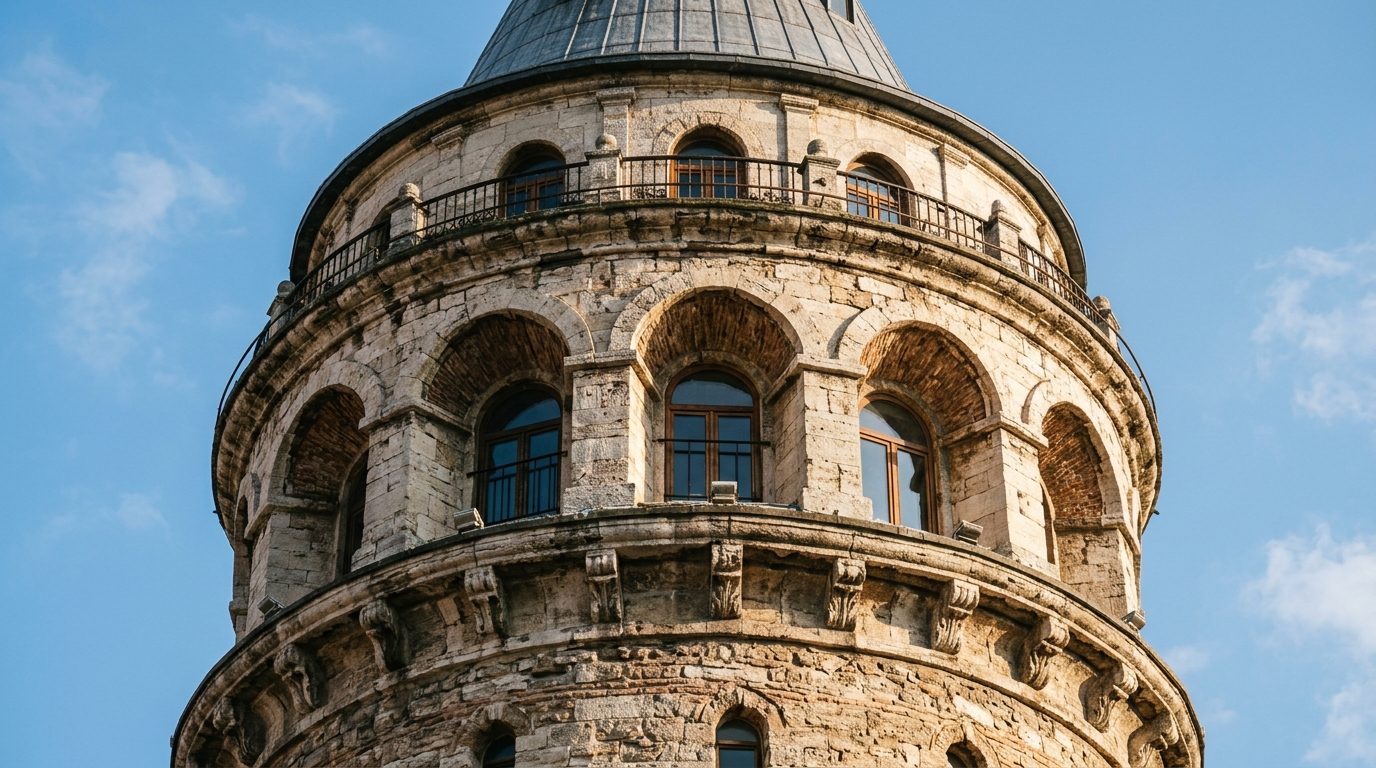
Galata Tower was built in 1348–1349 by the Genoese, who crowned the walls of their trading colony with a great stone keep and named it Christea Turris — the Tower of Christ. Everything else in the tower’s history flows from that founding act: it has since served the Ottomans as a fortress store, a prison, a fire lookout and an observatory of sorts, lost its roof to a storm, gained it back in a 20th-century restoration, and reopened in 2020 as a museum. Around 675 years old, it remains the most complete piece of the Genoese city that once faced Constantinople across the Golden Horn.
Below, the whole story era by era, with a timeline at the end. For what the building looks like from the inside today, see inside the tower.
Before the tower: the chain and the first keep
The hill of Galata mattered long before 1348. The northern anchor of the great chain that closed the Golden Horn to enemy fleets sat on this shore, guarded by a Byzantine tower known as the Megalos Pyrgos — the Great Tower. When the Fourth Crusade fell on Constantinople in 1203–1204, that tower was a first target: the crusaders stormed it, broke the chain, and the old keep was destroyed. The tower you visit today is not its rebuild but its successor on higher ground, raised a century and a half later by different masters entirely.
Why the Genoese were here at all
In 1261 the Byzantine emperor Michael VIII Palaiologos, needing a navy to retake Constantinople from the Latins, promised the republic of Genoa a trading quarter across the Golden Horn. The Genoese settled Galata — they called it Pera, “the other side” — and spent the next two centuries turning a concession into a fortified mini-state. The Byzantines repeatedly forbade them to build walls; the Genoese repeatedly built them anyway, wall by wall, “house by fortified house.”
The tower of 1348 was the crown of that defiance: the highest point of the circuit, a keep from which the whole colony, the harbour and the imperial city opposite could be watched. At roughly 63 metres it was the tallest structure in the region, and it made the point it was designed to make — Galata was Genoese, and intended to stay that way.
1453: the conquest that spared the tower
When Mehmed II besieged Constantinople in 1453, Genoese Galata walked a diplomatic tightrope: officially neutral, quietly useful to both sides. It saved the colony. After the city fell, Galata surrendered by negotiation rather than storm, and its people kept their homes and churches under Ottoman rule. The land walls were ordered reduced, but the great tower was kept — too useful to demolish. The Ottomans knew a good watchtower when they conquered one.
Prison, arsenal, launch pad
Ottoman centuries gave the tower a string of working lives. Under Süleyman the Magnificent it held prisoners of war condemned to labour in the naval dockyards at nearby Kasımpaşa. It stored equipment for the fleet. The chief astrologer Takiyüddin is said to have observed the stars from its upper floor before his short-lived observatory was built. And in the 1630s it entered legend: the polymath Hezarfen Ahmed Çelebi is said to have leapt from the tower’s summit on artificial wings and glided across the Bosphorus to Üsküdar — a tale told by the traveller Evliya Çelebi, and retold in full in our article on the legend.
Two hundred years of watching for fire
From 1717 the tower took the job it held longest: fire lookout. Istanbul was a city of timber houses, and from the tower’s gallery watchmen scanned the rooftops day and night, sounding drums and dispatching runners when smoke rose. The irony was cruel — the fire tower kept burning. The great Tophane fire of 1794 gutted it under Sultan Selim III; another fire in 1831 damaged it again, and Sultan Mahmud II’s rebuild that followed gave the tower two more floors and a new profile. In 1875 a violent storm tore away its conical roof entirely, and for ninety years the tower stood flat-topped, wearing a succession of makeshift caps.
The 20th century: a roof regained, a city’s viewpoint
The restoration of 1965–1967 remade the tower for the modern city. The interior was rebuilt in reinforced concrete, an elevator was threaded up the shaft, and — most visibly — the missing conical roof was finally restored to the medieval silhouette every photograph now shows. In 1967 the tower opened to the public for the first time as a visitor attraction, with upper floors that served over the decades as a restaurant and nightclub.
2020: the museum era
In 2020 the tower passed to Türkiye’s Ministry of Culture and Tourism, which stripped out later additions, restored the stonework and reopened it that October as the Galata Tower Museum. Exhibition floors now tell the story you have just read — the chain, the Genoese, the fires, Hezarfen’s flight — on the way up to the balcony. The tower is also on UNESCO’s Tentative List as part of the Genoese fortification heritage. What the museum route includes is covered in inside the tower; the 2020 restoration has its own article.
What does “Galata” mean?
No one is certain — which is fitting for a district of traders from everywhere. The two leading theories: from the Greek galaktos (“milk”), after the dairy pastures that once covered the hillside, or from the Italian calata, a sloping quay street — which describes the quarter perfectly to this day. The Genoese themselves preferred Pera, and both names survived side by side for centuries.
Galata Tower history at a glance
| Year | Event |
|---|---|
| 1204 | Byzantine chain tower (Megalos Pyrgos) destroyed by the Fourth Crusade |
| 1267 | Genoese settle Galata under treaty with Byzantium |
| 1348–1349 | Genoese build the present tower — Christea Turris |
| 1453 | Ottoman conquest; Galata surrenders peacefully, tower preserved |
| 16th c. | Used as a prison and naval depot under Süleyman |
| c. 1630s | Hezarfen Ahmed Çelebi’s legendary flight to Üsküdar |
| 1717 | Becomes the city’s fire-watch tower |
| 1794 & 1831 | Badly damaged by the fires it watched for |
| 1875 | Storm destroys the conical roof |
| 1965–1967 | Full restoration; roof rebuilt, elevator added; opens to visitors |
| October 2020 | Reopens as the Galata Tower Museum |
Seven centuries on, the tower still does its original job — watching the city — except now the watchers are visitors, and the city watches back. To stand where the watchmen (and one alleged aviator) stood, check the opening hours and get your entry ticket in advance; the balcony queue moves faster than the ticket line ever did.