
Galata Tower Legends: Hezarfen's Flight & a Love Story
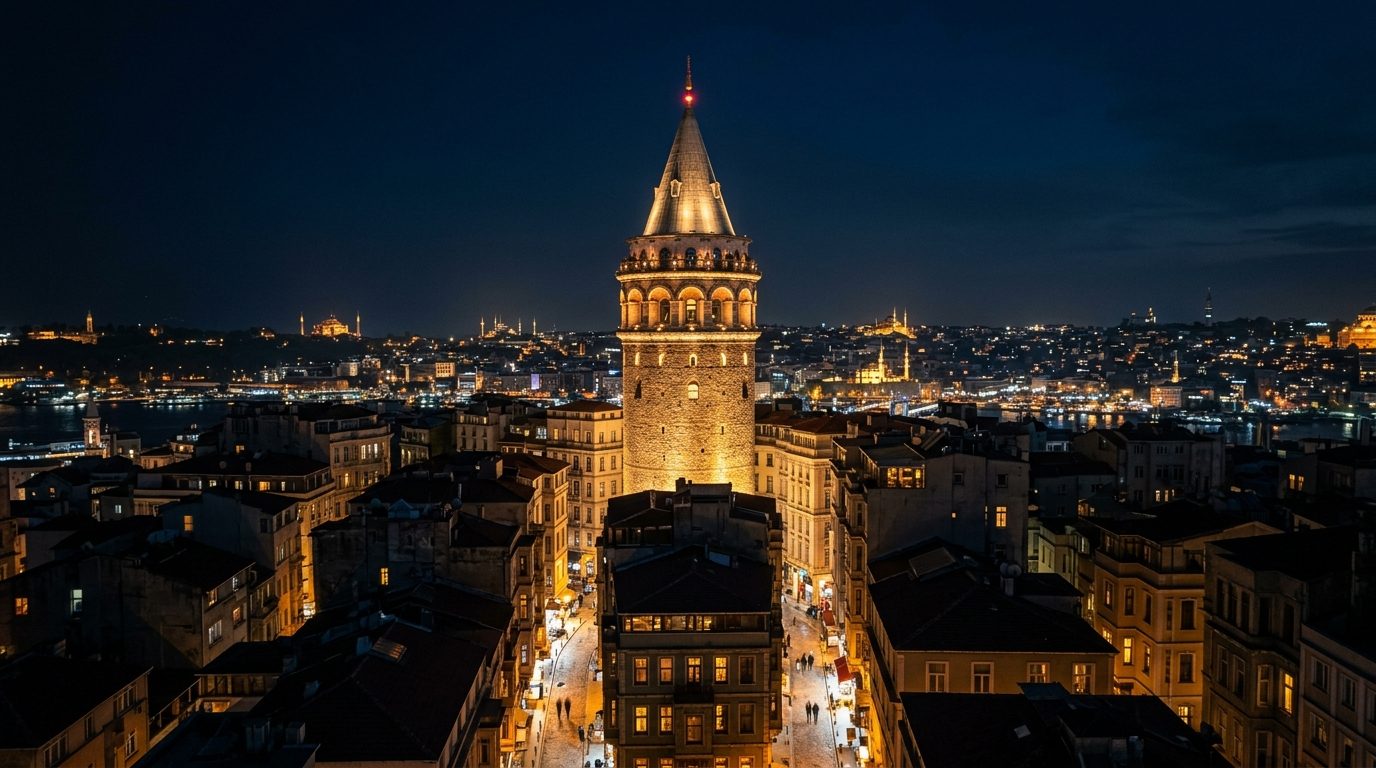
Galata Tower carries two legends: the story of Hezarfen Ahmed Çelebi, who is said to have flown from its summit across the Bosphorus on home-made wings in the 1630s, and the folk tale that the tower is in love with the Maiden’s Tower across the water. One comes from a 17th-century travel book and may contain a grain of truth; the other is pure romance invented by a city that cannot look at two towers without writing them a relationship. Both are told on the tower’s own exhibition floors, and both are better with the full details.
The flight: Hezarfen Ahmed Çelebi
The story comes to us from exactly one source — the Seyahatname of Evliya Çelebi, the great Ottoman traveller, who wrote that in the reign of Sultan Murad IV (1623–1640) a scholar named Ahmed Çelebi built himself wings of eagle feathers and practised gliding on the winds of Okmeydanı, the archery grounds above the Golden Horn.
Then came the famous day. Watching for a strong south-west wind — the lodos that still rattles Istanbul’s windows every winter — Ahmed climbed to the top of Galata Tower. Below, by Evliya’s telling, half the city had gathered to watch. He leapt, caught the lodos, and glided clear across the Bosphorus, landing in Doğancılar Square in Üsküdar on the Asian shore — a crossing of some three kilometres, from a launch point about 63 metres up (the tower’s real dimensions are here).
For this he earned the name Hezarfen — “a thousand sciences,” the polymath. And then the story takes its most Ottoman turn.
The reward and the exile
Murad IV, says Evliya, watched the flight from the Sinan Pasha mansion at Sarayburnu and was delighted. He summoned Ahmed, praised him, and filled his hands with gold. Then he reflected — and decided that a man capable of anything he wished was a dangerous man to keep around a throne. Hezarfen was exiled to Algiers, where he died. Evliya’s dry epitaph: “This is a man to be feared.”
Historians treat the whole account with care. Evliya was a magnificent writer with a magnificent imagination, no other contemporary source mentions the flight, and a three-kilometre glide on feather wings strains aerodynamics. But the legend has earned something better than verification: Istanbul’s second airport bears Hezarfen’s name, the flight scene appears in countless retellings, and every visitor who steps onto the tower’s balcony and feels the wind can decide for themselves how believable a running leap into the lodos really is.
The other flight in the family
The Çelebi household was apparently big on aviation. Evliya also credits Hezarfen’s brother, Lagâri Hasan Çelebi, with riding a seven-winged gunpowder rocket into the sky over the Bosphorus to celebrate the birth of Murad IV’s daughter in 1633 — splashing down safely and telling the sultan, “I bring you greetings from Jesus.” He got gold too (and, the pattern holds, later left the capital). Between the two brothers, Galata can claim to be the launch site of both fixed-wing and rocket flight — pending, as always, peer review from the 17th century.
The love story: two towers across the water
The second legend needs no sultan. Out in the Bosphorus, off the Asian shore, stands the small white Maiden’s Tower (Kız Kulesi) — home to its own ancient tale of a princess locked away to cheat a prophecy of death by snakebite. Folklore married the two monuments: Galata Tower, the tall dark sentinel of the European shore, fell in love with the Maiden’s Tower, the unreachable white islet across the strait.
In the telling, the towers exchange whispered messages by wind and current, doomed to gaze at each other forever without touching — and Hezarfen’s flight becomes the love story’s climax: Galata Tower lent the aviator its heart, they say, so that something of it could finally cross the water. On a night when both towers are lit and the strait runs black between them, the city’s insistence on this romance stops needing explanation.
Standing where the legend starts
The exhibition floors inside the tower retell Hezarfen’s story on your way up, which is the right order: legend first, then the balcony, then the long look south-east across the water toward Üsküdar to judge the distance yourself. Go at a quiet hour to have the rail to yourself — the opening hours page lists them — and if you want the launch point without the crowd that watched Ahmed jump, arrange your entry ticket in advance; the wind, at least, is still free.